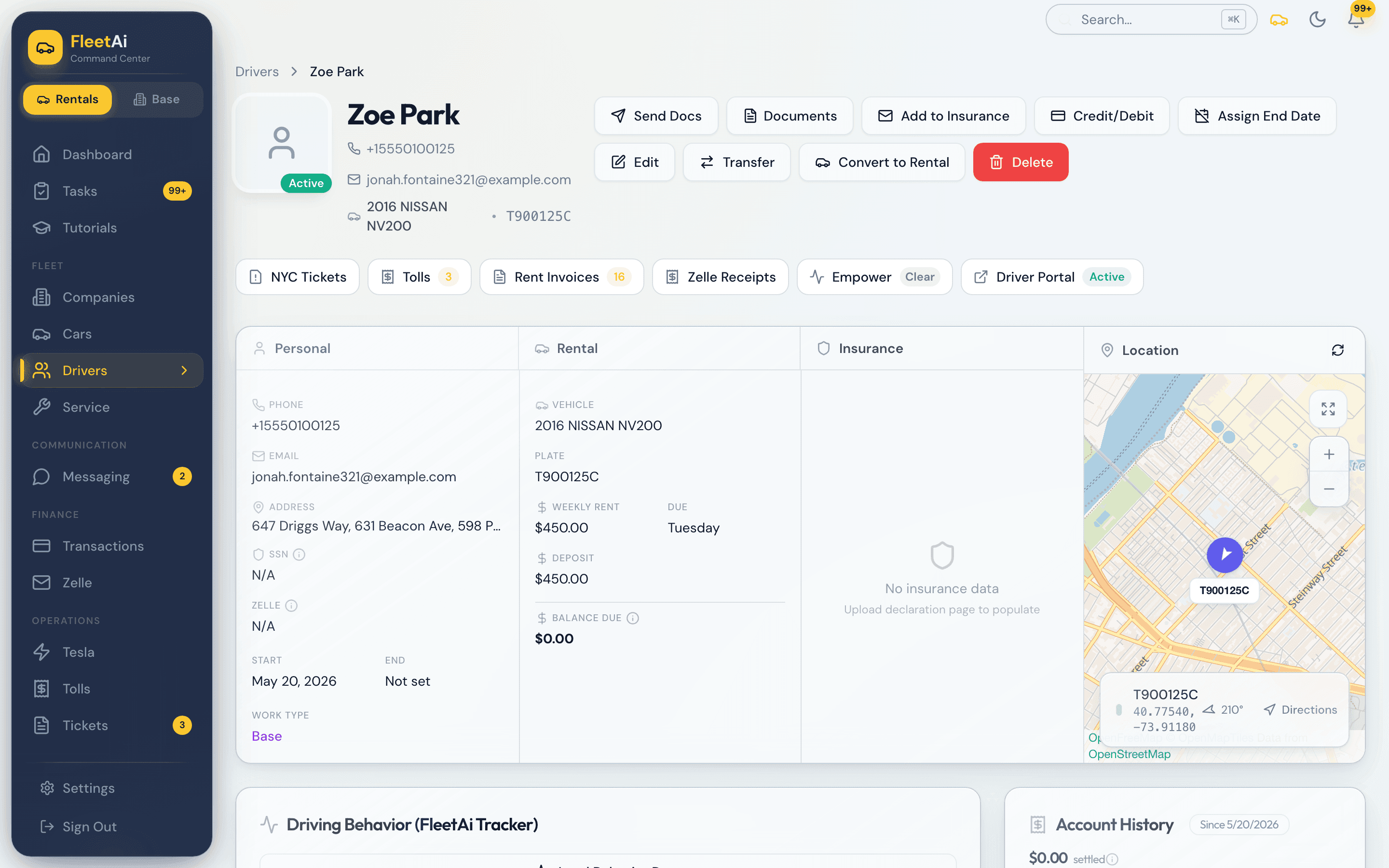
A balance is a running total, not a single fact
"He owes 400 dollars" sounds like a settled fact until someone actually asks how it got there. A driver's balance is really a running total: every charge added as it happens, every payment subtracted as it arrives, in order. Two different drivers can both owe 400 dollars and still be in completely different situations, one who missed a single week and one who has been slowly chipping away at a much larger amount for a month. The number alone does not say which.
That is why a balance worth trusting is never just a number on its own. It is a number with a history behind it that anyone, owner or driver, can open up and check line by line. Without that history, the number invites an argument the moment someone questions it, because there is nothing underneath to point to.
What should be on it
Rent is the anchor, added to the balance on the same schedule every single week regardless of who happens to be driving that car. Beyond that, whatever the lease specifically allows can join it: a toll passed through from an E-ZPass statement, a ticket transferred to the driver who was parked, a fee the lease names and explains. Anything not written into the lease has no business on the balance at all, because charging it would be an overcharge under TLC's own leasing rule, not a legitimate line item.
Payments come off the same list as they arrive, whatever the channel: Zelle, cash, card, or bank transfer. The balance is simply what is left once every charge and every payment for that driver are laid end to end, in the order they actually happened rather than the order they were noticed.
That ordering detail is easy to skip and expensive to skip badly. A fleet that only records the total someone paid this week, without keeping the individual charges that made it up, cannot answer the next question a driver asks: which week, exactly, is still open.
Why oldest-first matters
The order payments get applied in changes what the balance actually communicates. Apply a payment to the newest charge first, and a driver who pays late one week but on time every week after can look caught up indefinitely, while the one week they fell behind sits quietly unpaid underneath a string of on-time weeks. Apply it to the oldest charge first instead, and that same driver shows as exactly one week behind until that specific charge is paid off.
Oldest-first is not a TLC requirement; it is a bookkeeping choice, but it is the one that keeps a balance meaning "how far behind," rather than letting an old shortfall hide behind newer payments that happened to arrive on time.
The paper trail behind every line
None of this works as a private spreadsheet only the owner can see. TLC's rule requires a written receipt for every financial transaction under a lease, showing the date, the amount and how it was calculated, the purpose, and the specific lease term or rule that allows it. That requirement is what turns a balance from an assertion into something a driver can actually check.
A driver who can see the same receipts the owner is working from has a lot less reason to doubt the number at the top. A driver who only ever hears a total, with nothing behind it, has every reason to ask where it came from, and an owner without the receipts to answer is the one left explaining a number instead of showing one.
Questions fleets ask
- What should count toward a driver's balance besides rent?
- Whatever the lease specifically allows, such as tolls or tickets passed through to the driver, or fees named in the lease. A charge that is not written into the lease should not appear on the balance at all.
- Why apply a payment to the oldest charge instead of the newest?
- So the balance keeps meaning what it says. If a late payment covered this week's rent instead of last week's, the driver would look caught up while an older charge sits unpaid underneath it.
- Does the TLC require a specific balance format?
- Not a format, but it does require a written receipt for every financial transaction under the lease, itemized enough that a driver can check the date, the amount, the calculation, and the reason behind it.
- Can a driver ask to see how a specific charge was calculated?
- Yes. TLC's rule already requires that calculation to appear on the receipt for that transaction, so ask for the receipt tied to the specific charge if the number is not clear.
Sources
- NYC Taxi and Limousine Commission, Rules, Chapter 59 (For-Hire Vehicle Owners), Section 59A-21: Leasing a For-Hire Vehicle
- NYC Taxi and Limousine Commission, Driver Protection Unit
- Zelle, Using Zelle
Built and used every day by a working NYC TLC fleet.