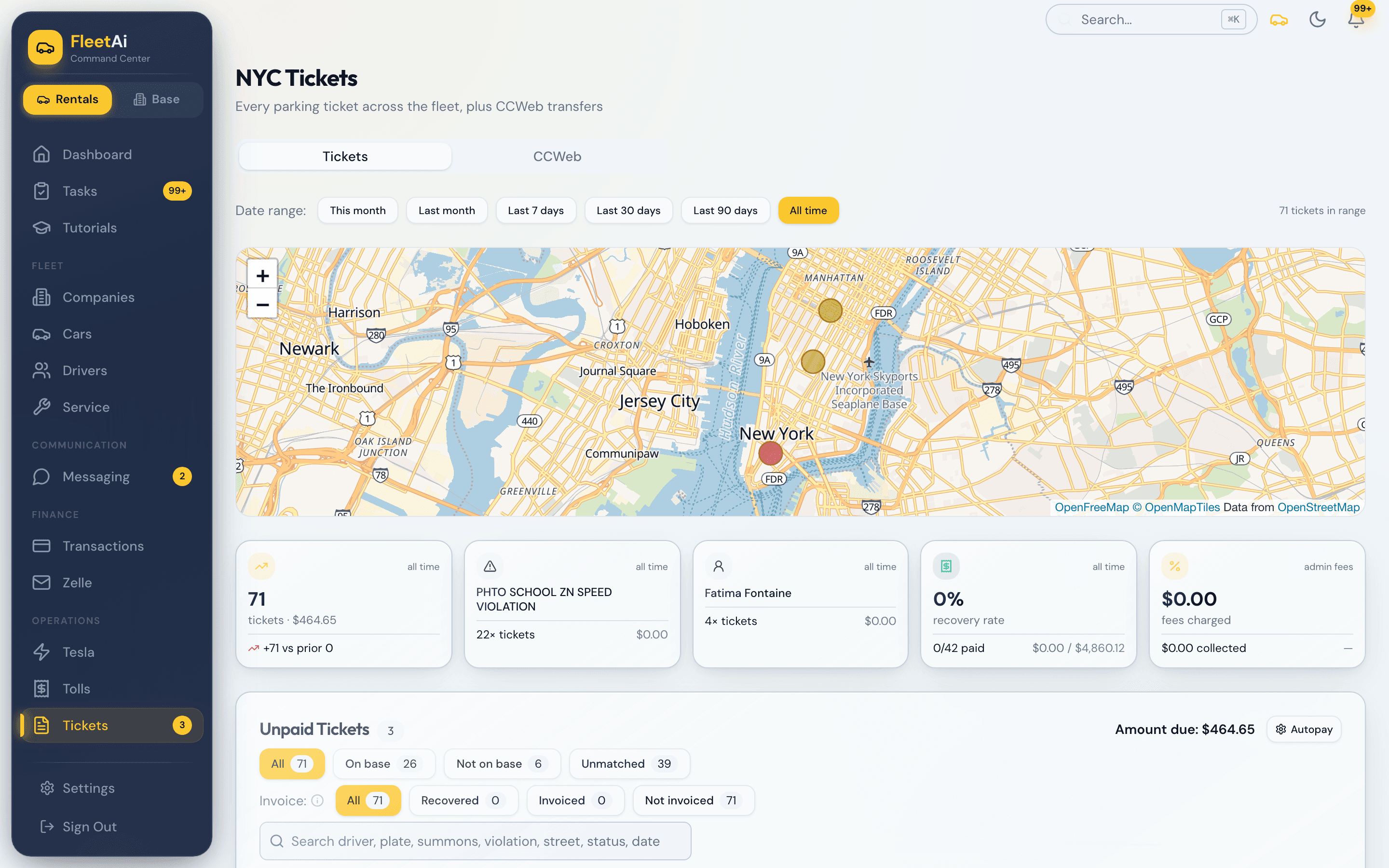
Three systems, and none of them talk to each other
A parking or camera ticket lives in the Department of Finance's CityPay system, searchable by violation number or one license plate at a time. A TLC summons does not show up there at all, and it is excluded by name from the general Summons Finder run by OATH, the city's independent hearing agency, which does not cover for-hire vehicle summonses. You look those up instead through TLC UP or LARS, TLC's own tools, or a separate For Hire Vehicle Case Calendar that is not updated once a hearing gets rescheduled. Three systems, three logins, and a fleet with twenty plates means running the same search twenty times in each one, on whatever schedule you remember to do it.
CityPay also assumes you already know which plate to check. It has no view across a whole fleet, only a single plate or a single violation number per search, so it never surfaces a ticket on its own. A fleet that has no reason to suspect a problem on a given car has no reason to go looking, until a renewal application or a boot turns up something nobody knew about.
What the Fleet Program actually consolidates
DOF's Fleet Program narrows this some. Enroll every plate, and CCWeb, the shared portal for Fleet and Rental Program participants, gives you a weekly report of new and outstanding violations across all of them in one place, without twenty separate searches. That covers parking and camera tickets together. It does not cover TLC summonses, which still live in TLC's own systems, so a fleet running TLC vehicles and a Fleet Program enrollment ends up checking two consolidated views instead of one, rather than a single unified one.
The benefit also depends on keeping the enrollment itself current: adding a plate when a car joins the fleet, terminating one when it leaves, and completing the program's own annual contact update on time. A plate that never gets added is a plate CCWeb was never watching in the first place, and it still falls back on the single-plate search in CityPay.
NYC Open Data holds the same tickets, in bulk
The city also publishes its parking and camera violations as a public dataset, searchable by plate, violation type, and fine amount, going back years. It is not built for day-to-day fleet management: there is no login, no per-driver billing, and no way to attach a hearing date the way CCWeb or TLC UP can. What it is good for is spot-checking a specific claim, such as confirming a fine amount on a violation code, or reconstructing a plate's history when the original notice is long gone. It will not tell you what is new since yesterday, and it says nothing about TLC summonses, which are not DOF records at all.
Watch for fake notices too
DOF has flagged a scam making the rounds: text messages demanding payment for a "notice of default" on a parking violation, complete with a barcode to scan. DOF says plainly that these are not from the city or the state, and that you should never scan the code or send money based on one. A ticket's real status lives in CityPay, CCWeb, or TLC UP, never in a text message, and none of those systems will ever ask you to pay by scanning a code from an unsolicited text.
What "checking" actually has to answer
A plate number and a dollar amount are not enough. The useful version of checking for tickets answers four things for every open item: is it a parking ticket, a camera violation, or a TLC summons; is it still open or already resolved; how close is it to its deadline, whether that is a 30-day hearing window, a 100-day judgment date, or a TLC hearing date; and which driver had the car at the time. A ticket that reads "double parking, twenty-two days old" is routine. The same ticket at ninety-five days, on a plate already carrying two others in judgment, is a car that could be booted this week. Without the driver's name attached, everything before that point is just a list of numbers with no owner.
Questions fleets ask
- Is there one government site that shows every kind of NYC ticket at once?
- No. Parking and camera tickets live in DOF's CityPay and, for enrolled fleets, CCWeb. TLC summonses live in TLC UP and LARS, and OATH's general lookup tool explicitly excludes for-hire vehicle summonses.
- Does enrolling in the Fleet Program cover TLC summonses too?
- No. It consolidates parking and camera violations across enrolled plates. TLC summonses are a separate system entirely, tied to the license rather than the plate.
- How do I know a ticket payment demand is real?
- Check it directly in CityPay, CCWeb, or TLC UP rather than a text or email link. The Department of Finance has warned that scammers are texting fake default notices with a barcode to scan, and none of that comes from the city.
- Can NYC Open Data fill the gap?
- It holds the same parking and camera tickets, plate by plate, as a public dataset, which is useful for spot-checking a claim or building your own record. It does not include TLC summonses, and it is a bulk export, not a live account, so it will not tell you what changed since yesterday.
Sources
- NYC Department of Finance, Parking Ticket Services
- NYC Department of Finance, Fleet Programs
- NYC Department of Finance, Commercial Customer Online Services (CCWeb) User Guide
- NYC Taxi and Limousine Commission, TLC Upload Portal (TLC Up)
- NYC Office of Administrative Trials and Hearings, Case Status
- NYC Open Data, Open Parking and Camera Violations
Built and used every day by a working NYC TLC fleet.