Why the ticket is yours before it is anyone else's
A parking ticket is decided against the plate's registered owner, not the person who was driving. If a Traffic Enforcement Agent writes it, it goes on the windshield. If a camera catches it, a Notice of Liability goes in the mail days or weeks later. Either way, the city does not ask who was behind the wheel. It bills the name on the registration, and in a rental or lease fleet, that name is you.
New York City adjudicates these as civil matters through the Department of Finance, not as criminal charges, and they carry no license points. That is a low bar for the city to clear and a hard one for you to argue around later, since the ticket itself almost never records who was actually parked.
This piece covers ordinary DOF tickets: the kind an agent writes by hand or a camera captures automatically. A TLC summons is a different animal entirely, decided under different rules by a different court, and it gets its own explanation. The two are easy to confuse because both arrive as paper with a fine attached, but a fleet needs a separate answer for each.
Two programs built for exactly this problem
DOF runs several commercial programs for businesses that manage more than one plate. Two of them, the Stipulated Fine Program and the Commercial Abatement Program, are built for delivery and service businesses willing to trade their right to a hearing for a reduced fee; they solve a narrower problem than most rental fleets have, since the fine still needs to land on the driver who was parked, not just get paid down cheaply. The two that matter for a fleet renting cars to drivers are the Fleet Program and the Rental Program, and they solve different halves of the same problem.
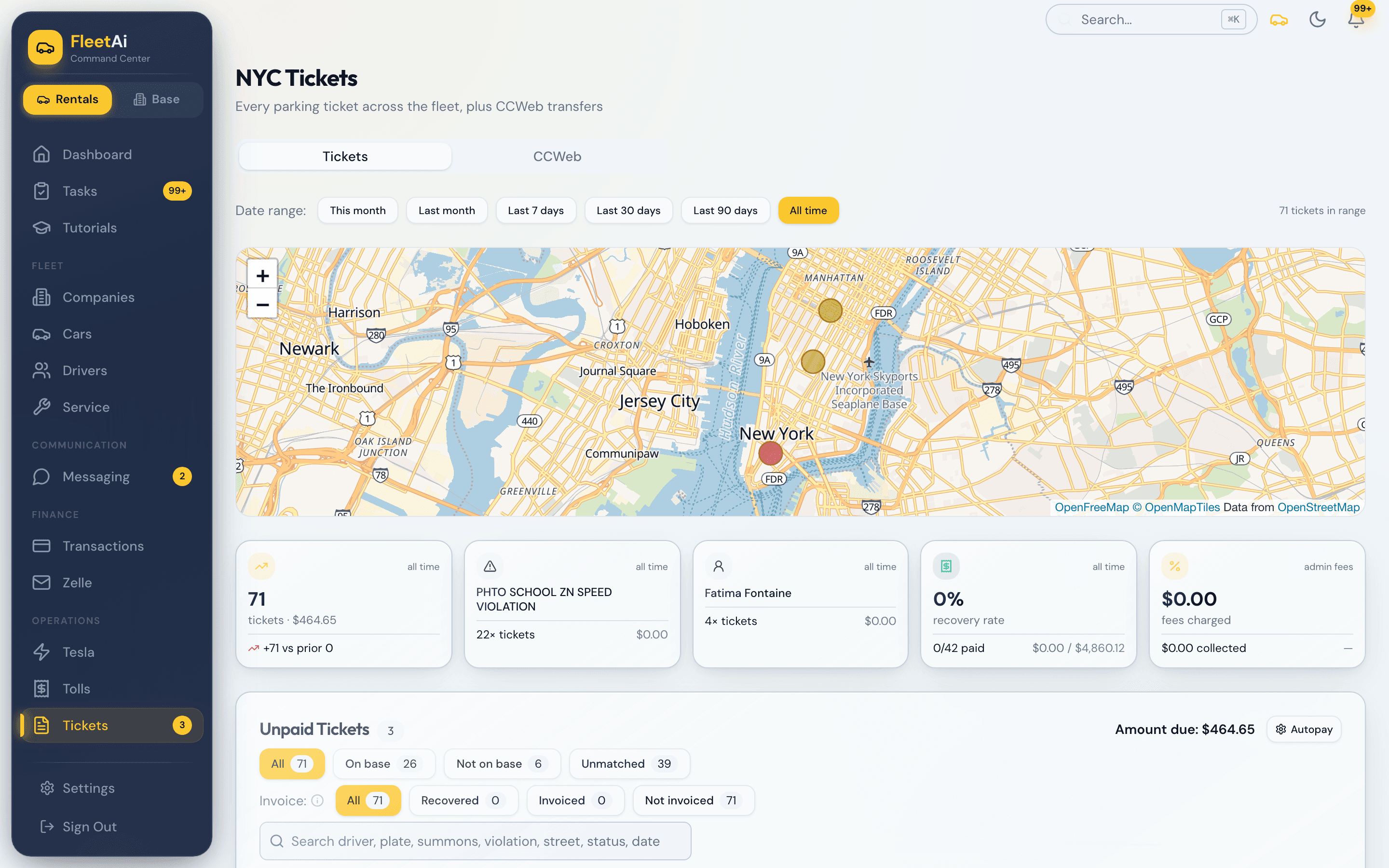
The Fleet Program is for a business with at least one vehicle registered or leased in its name. Enroll, and you get a weekly report of new and outstanding violations across every plate, plus a shared portal called CCWeb, short for Commercial Customer Online Services, to review each one, pay it, or request a hearing. If your company leases its cars from another owner, a Lease Rider tells DOF to mail the violation notices to you instead of the vehicle's registered owner, though that owner stays jointly liable for the fines under state law until they are paid.
The Rental Program goes further: it moves the liability itself, not just the mail. It is built for businesses that rent or lease vehicles to someone other than the registered owner, which describes most fleets that put drivers in their cars. Enroll a plate, and DOF gives you 54 days from each violation to submit the driver's correct name and address. Once DOF verifies it, the ticket becomes the driver's on record, not the fleet's. Miss the window and it stays with the registered owner. Enrollment runs on an annual July to June cycle and costs $1 per plate per month.
Both programs share the same CCWeb portal to search enrolled plates, request hearings, and upload evidence.
The Fleet Program's own clock
Enrolling changes more than where the notice goes. It also changes the penalty schedule. Outside any program, a parking ticket picks up its first penalty at 30 days. Inside the Fleet Program, that grace period runs to 60 days before a $10 penalty, another 30 days before a $20 penalty on top of it, and a further 45 days before a $30 penalty, ahead of judgment. A camera violation gets 60 days before its first $25 penalty and 30 more before judgment.
The tradeoff is a hard ceiling rather than a longer leash. A Fleet or Stipulated Fine Program participant whose judgment debt passes $350 is terminated from the program outright and becomes subject to the same booting and towing as a plate that was never enrolled. The extra runway only helps if someone is actually using it to catch up, not to stop paying attention.
Three ways fleets actually handle tickets
| Method | Effort each week | What goes wrong |
|---|---|---|
| Pay tickets from company funds, never bill drivers | None | The fleet subsidizes whoever parks worst. |
| Print DOF's report, chase drivers by hand | Hours: match plates to drivers, track down each one | A camera ticket that arrived three weeks late has no obvious owner by the time anyone looks. |
| Enroll plates in the Rental Program, bill by the driver's dates on the car | Minutes, to review exceptions | Needs each driver's start and end date on the car to be right, and the 54-day window respected. |
Matching a ticket to the driver who was parked
The rule is the same whether the ticket came from an agent or a camera: whoever had the car at the time it was written owes it. What makes that hard is timing. A windshield ticket usually shows up the same week. A camera violation can take longer, since the Department of Transportation has to review the images before DOF mails the Notice of Liability, and by then the car may already be with a different driver.
If your records hold each driver's start and end date on each car, a late ticket still finds the right person on its own. If those dates live in a notebook or a group chat, a ticket from three weeks ago finds nobody, and it sits on the fleet's account collecting penalties while everyone assumes someone else is handling it.
A driver who disputes a ticket adds a second date to track: the hearing itself. And a closed ticket is not always the last word. If DOF later determines a ticket was dismissed on false evidence or testimony, it can reinstate it, so the record is worth keeping even after a ticket is marked paid or dismissed.
Why the clock matters more than the fine
A single parking ticket is rarely the problem. What costs a fleet money is the ticket nobody answered. Miss both the payment and the hearing window, and a ticket enters judgment at around 100 days outside the Fleet Program, at which point it starts drawing interest and the city can send the debt to a collection agency. Once a plate's judgment debt passes $350, that car becomes eligible for a boot or a tow, and it stays that way until the balance is paid or a payment plan is in place. A fleet that believes it was charged after already paying, or after a ticket should have been dismissed, can raise it through DOF's Office of the Parking Summons Advocate, but that is a correction path, not a substitute for answering a ticket on time.
For a TLC fleet specifically, there is a second cost that has nothing to do with money. Renewing a for-hire vehicle license requires paying off fines owed to the Department of Finance for parking, red light, and other violations first. A stack of ignored tickets does not just sit on a statement. It can hold up the paperwork that keeps the car legally on the road.
Questions fleets ask
- Can a parking ticket actually be transferred to the driver who was parked?
- Yes, through the Department of Finance's Rental Program. An enrolled plate gets 54 days from the violation to submit the driver's correct name and address, and once DOF verifies it, the ticket becomes the driver's. Miss the window and it stays with the registered owner.
- Does enrolling in the Fleet Program mean DOF disputes tickets for me?
- No. It gives you a weekly report and a portal to review, pay, or request a hearing on every enrolled plate. Someone still has to decide, ticket by ticket, whether to pay it or contest it.
- What actually happens if tickets sit unpaid?
- After about 100 days a ticket goes into judgment and starts drawing interest. Once judgment debt on a plate passes $350 the car can be booted or towed, and the same unpaid fines have to be cleared before a for-hire vehicle license can be renewed.
Sources
- NYC Department of Finance, Parking or Camera Tickets
- NYC Department of Finance, Fleet Programs
- NYC Department of Finance, Rental Program
- NYC Department of Finance, Commercial Customer Online Services (CCWeb) User Guide
- NYC Department of Finance, Tickets in Judgment
- NYC Taxi and Limousine Commission, Renew a For-Hire Vehicle License
Built and used every day by a working NYC TLC fleet.