Why the toll is your problem first
The tag is on the car and the account is in the fleet's name, so the authority bills you. Whether a driver pays you back is between you and the driver, and the statement will not settle it. It lists a plate, a plaza, and a timestamp, not a person.
Two kinds of charges show up. Tag reads post within a day or two. Plate reads, the ones charged when the tag did not register, post later and at a higher rate. On a busy fleet the second kind arrives after the driver's week has already been invoiced.
Tag reads, plate reads, and the rate in between
A tag that is mounted and working gets read by radio at the crossing and billed at the standard rate. Paying by E-ZPass costs at least 25 percent less than paying without one, according to the Metropolitan Transportation Authority. A tag that is not mounted, has a dead battery, or sits behind a windshield that blocks the signal does not make the crossing disappear. A camera reads the plate instead.
At MTA Bridges and Tunnels crossings, such as the RFK Bridge or the Verrazzano, a plate read on a car that has a working account posts at a mid-tier rate the authority created for exactly this gap: higher than the tag rate, lower than the rate charged to a car with no E-ZPass account at all. A different agency, on a different bridge or a highway plaza, may instead send a Tolls by Mail bill or a violation notice for the same missed read, so the outcome depends on which facility the car crossed.
A car with no E-ZPass account on file at all is a separate problem. The New York State Thruway Authority, which runs the E-ZPass New York customer service center, says a Tolls by Mail bill goes out 30 to 45 days after the trip, built from the plate photograph and mailed to the vehicle's registered owner, which for a fleet car is the fleet. Either way, a plate-posted charge is worth a second look before it goes on an invoice: E-ZPass New York will review an occasional missed tag read and credit the difference between the mid-tier rate and the standard rate, but only once someone asks.
What the E-ZPass Business statement actually shows
A statement is not one number. It opens with a summary: tolls for the period, any overdue balance carried from before, late or other fees, credits, and a total amount due with the date payment has to arrive by.
Underneath that summary sits the detail, one line per crossing. Every line carries the same handful of fields no matter which bridge, tunnel, or highway plaza produced it.
| On the statement | What it tells you |
|---|---|
| License plate | Which car made the crossing, the same plate the matching rule runs on |
| Agency | Which authority runs that crossing: a bridge and tunnel authority, a state highway authority, or the Port Authority of New York and New Jersey |
| Facility, or entry and exit facility | The plaza, bridge, or tunnel the car actually crossed |
| Class | The vehicle classification the crossing was billed under, which sets the rate |
| Date and time | Precise enough to match against the car's own trail that day |
| Toll amount | What that single crossing cost, at whichever rate applied |
The agency column matters more than it looks. A fleet crossing the RFK Bridge, the Verrazzano, and a Thruway plaza upstate in the same week sees three different agencies on one statement, each with its own rules, billed through the same account. Logging into the account online or through the Tolls NY app shows current and historical crossings and flags any toll that posted from a plate instead of a tag, so a mid-tier charge does not sit disguised inside an ordinary-looking line.
Three ways fleets recover tolls
Most fleets in the city do one of these. The third is the only one that survives a driver leaving mid-month.
| Method | Effort each week | What goes wrong |
|---|---|---|
| A flat toll allowance inside the rent | None | Light drivers subsidize heavy ones. Airport runners cost you money every week. |
| Pass the statement through by hand | Hours: match plates to drivers, type each line | Late plate reads get missed. Disputes come down to memory. |
| Match every crossing to the driver's dates on the car, invoice weekly | Minutes, to review the exceptions | Needs each driver's start and end date on each car to be right. |
Matching a crossing to a driver
The rule is simple: whoever had the car at the timestamp owes the toll. What makes it hard is that cars change hands. A driver returns a car on Tuesday, the next driver takes it Wednesday, and a plate read from Monday posts the following week. If your records hold each driver's start and end date on each car, the crossing finds its driver on its own. If those dates live in a group chat, it finds nobody.
- Keep the dates per car, not per driver. A driver who moves between two cars has two tenures.
- Bill tolls on their own line, never folded into rent. Rent is the same every week; tolls are not.
- Hold late tolls against the driver's balance, including the final one after they leave.
Proof settles the dispute
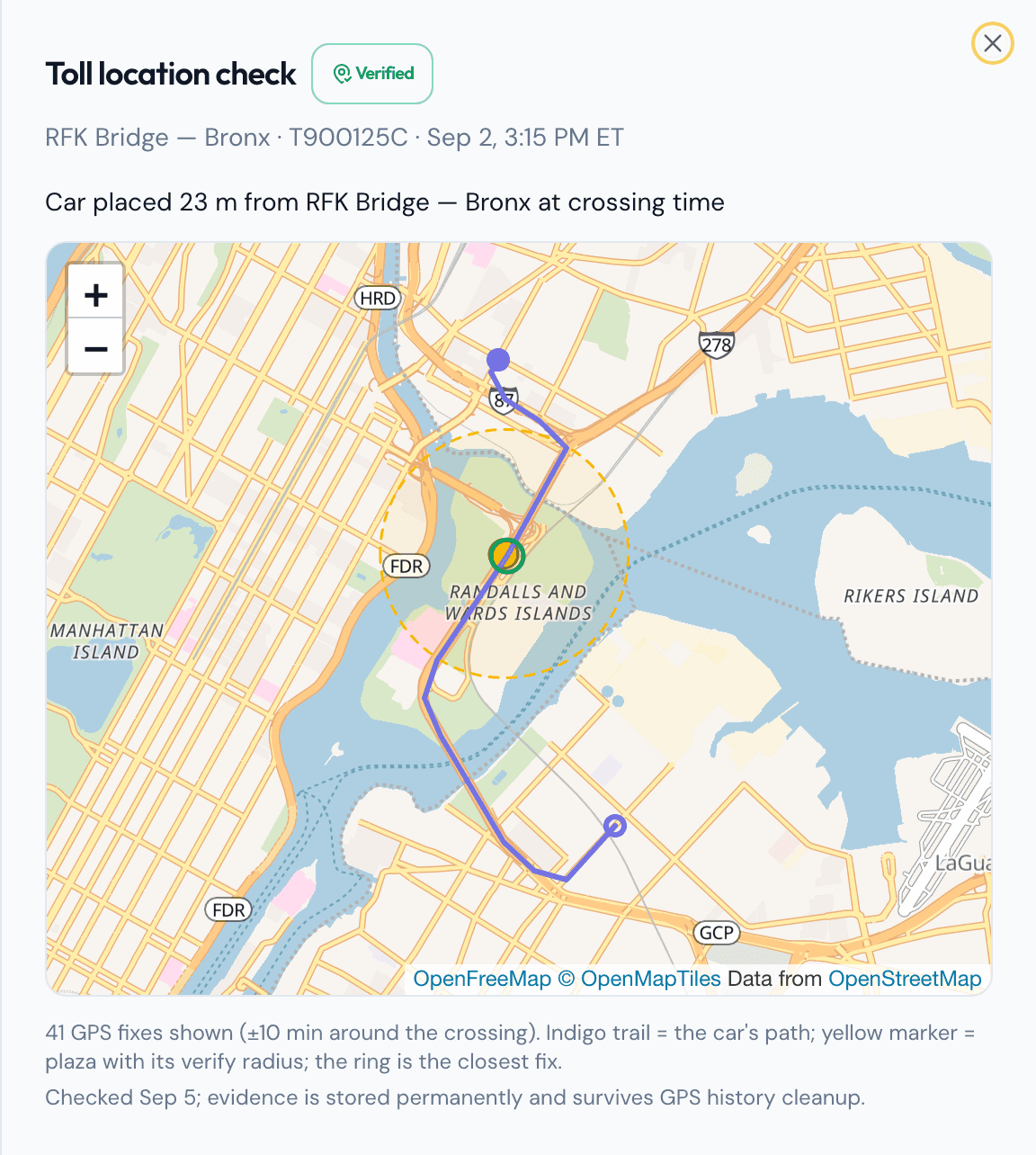
"That wasn't me" is the sentence every fleet hears. The answer is the car's own location trail. If the car's GPS puts it at the plaza within a minute of the crossing, there is nothing left to argue about. If it does not, you have found a misread plate, and the dispute belongs with the toll authority rather than the driver. Either way the conversation is over in one message, with a picture.
Take the dispute to the authority, not the driver
A misread plate is not a driver problem, so do not turn it into one. The car's own trail either puts it at the plaza or it does not; once it does not, the fix runs through the toll authority, not a conversation with whoever was driving that week.
For a charge that posted to the account at the mid-tier rate, ask E-ZPass New York to review the tag history and credit the difference. For a Tolls by Mail bill addressed to the fleet for a plate it does not recognize, the bill itself carries a dispute process: state the reason, attach whatever supports it, such as a bill of sale or a police report for a stolen plate, and return it before the payment date. If the customer service center will not resolve it, the Office of the Toll Payer Advocate, an independent office inside the Metropolitan Transportation Authority, is the next stop.
Putting it on the invoice
Tolls belong on the weekly invoice as itemized lines: plaza, date, time, amount. A driver who sees "RFK Bridge, Tue 3:15 pm, $11.19" pays. A driver who sees "Tolls, $34.50" asks. Post them the week the statement arrives, apply payments to the oldest charge first, and show the same lines wherever the driver checks their balance.
A weekly toll routine for a ten-to-fifty-car fleet
A fleet this size crosses tolls faster than one person can eyeball crossing by crossing. A short routine, run on the same day every week, keeps the pile from forming.
- Pull the statement as soon as it posts and scan the agency column first. A crossing from an agency the fleet does not usually see is worth a second look before anything else.
- Set the mid-tier and plate-posted lines aside from the rest. These are the ones likely to need a dispute or a tag fix, not routine billing.
- Match every remaining line to a driver by the car's dates, not by memory. A car that changed hands mid-week needs both drivers checked against the timestamp.
- Post the matched lines to that week's invoice, itemized, before the balance closes for the week.
- Send the mid-tier lines to E-ZPass New York for review and the unmatched ones through the authority's dispute process, and hold both off the invoice until they come back.
- Once a month, check the account itself for a plate that dropped off, a tag that stopped reading, or a new car that never got added. A car with no working tag is what turns routine tag reads into avoidable Tolls by Mail bills.
None of this needs more than half an hour a week once the first pass is done. The part that takes longer is chasing a toll that should have been caught the week it posted.
Questions fleets ask
- Can I charge a driver for a toll that posted after they returned the car?
- Yes, if your agreement says tolls are the driver's and your records show they had the car at the time. Hold it against their final balance instead of writing it off.
- Are plate reads handled the same way as tag reads?
- Same rule, later arrival, higher amount. The cure is billing from the driver's dates on the car rather than from memory, so a crossing from three weeks ago still lands on the right person.
- Does the congestion charge show up like a toll?
- Not for TLC-licensed cars. They are not charged the zone toll; a per-trip charge is added to each fare instead, so it never reaches your E-ZPass statement.
Sources
- New York City Taxi and Limousine Commission, rules for for-hire vehicle owners and drivers.
- E-ZPass New York, Business account terms and Tolls by Mail rates.
- Metropolitan Transportation Authority, Congestion Relief Zone: taxis and for-hire vehicles.
- MTA, How to pay tolls in New York
- MTA Bridges and Tunnels, FAQs: Mid-Tier Toll Rate
- MTA, Office of the Toll Payer Advocate
- New York State Thruway Authority, About Tolls by Mail
- New York State Thruway Authority, sample Tolls by Mail bill
Built and used every day by a working NYC TLC fleet.