What a toll record actually shows
A camera at a plaza photographs a plate as a car passes. That is the entire record: a plate, a location, and a timestamp, nothing about who was behind the wheel. The same is true of a tag read; a radio antenna picks up an account number, not a face. When a driver says a toll was not theirs, they are usually right that the record alone cannot prove otherwise. It also cannot disprove it. Settling the question takes something else.
Where the misread comes from
Plates get misread. A plate that is dirty, bent, or simply photographed at a bad angle can return the wrong characters to the system reading it, often enough that the toll authorities build the possibility into their own dispute process. A Tolls by Mail bill can be disputed on the grounds that the vehicle had already been sold, with proof of sale, or had been reported stolen, with a police report. Neither reason has anything to do with a driver's word. Both are about whether the car in question was ever there at all, which is exactly the question a location record can answer without anyone's memory involved.
Two records that settle it
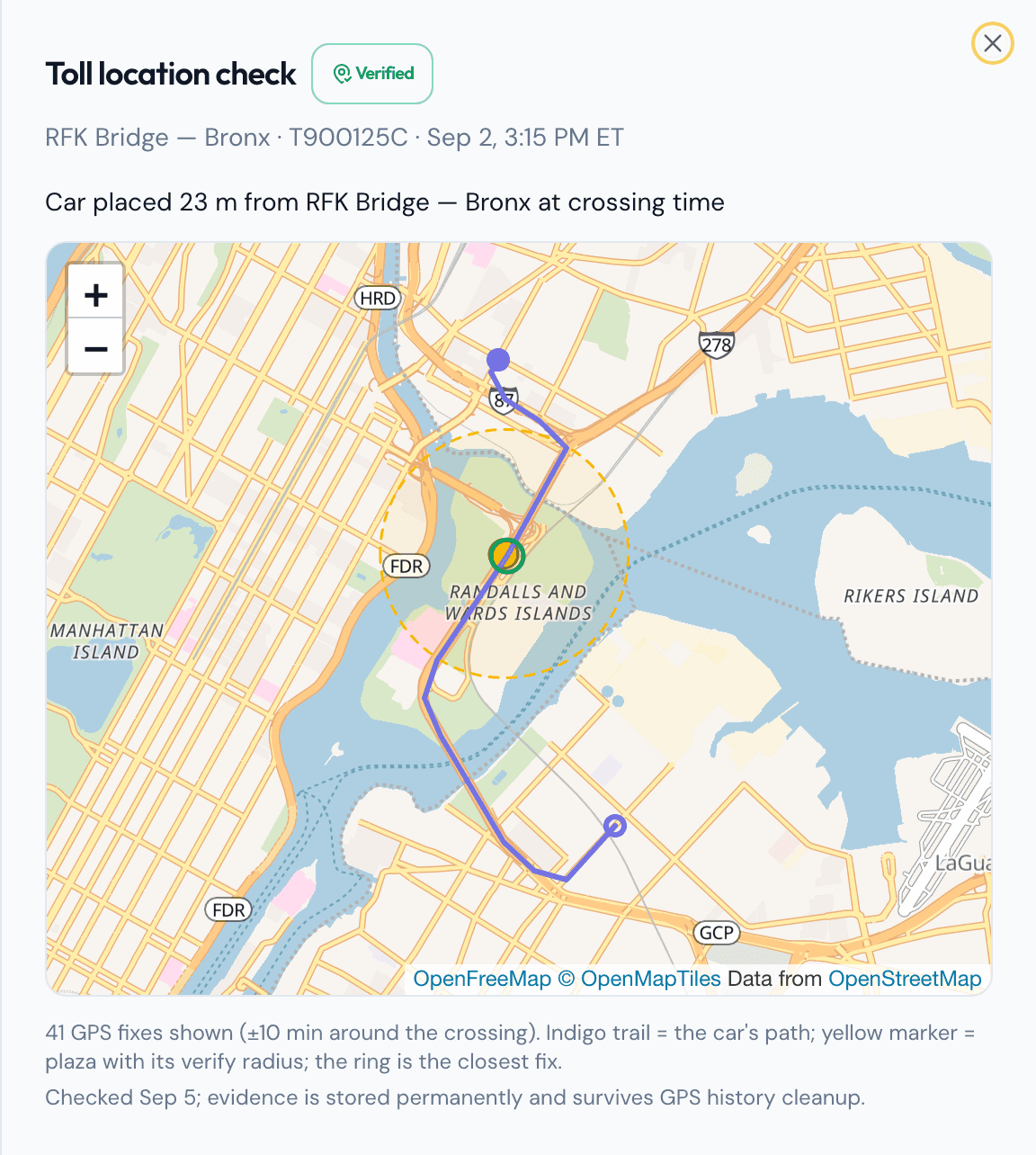
A fleet already has what it needs to answer the question itself, without asking the driver to explain themselves first. The driver's start and end date on that car says who had it at the timestamp on the bill. The car's own GPS trail says where the car actually was at that time. Line the two up against the plaza's location, at the exact date and time printed on the bill, and the crossing either checks out or it does not. Neither record depends on anyone's memory of a specific Tuesday, and neither one requires the driver to be right or wrong from the start.
What to do with each answer
If the trail puts the car at the plaza within a minute or two of the timestamp, the dispute is over: it was that driver's crossing, it belongs on their invoice, and the conversation ends with a picture instead of an argument. If the trail puts the car somewhere else entirely, the record is likely a misread plate, and that is a dispute between the fleet and the toll authority, not a fight with a driver who was never there. Either way, this settles what happened between a fleet and a driver. It is not the same as a formal dispute over the charge itself; if a charge is being contested with the toll authority, use its own process and whatever documentation it asks for, rather than treating the GPS trail as a substitute for that process.
Keep to the clock
An E-ZPass-billed toll can be disputed in writing within 180 days of the crossing, and a Tolls by Mail bill carries its own shorter list of accepted reasons. That sounds like time to spare, but the late fees on an unpaid bridge or tunnel toll move on their own thirty and sixty day schedule, whether or not anything is being disputed. Checking a questioned crossing against the car's trail while the account is still current, rather than after a fee has already landed, is the difference between a one-message answer and a longer one. If the toll authority's own customer service center cannot resolve a specific charge, MTA's Office of the Toll Payer Advocate exists for exactly that. It is independent of the enforcement side, deals directly with individual toll payers rather than anyone representing them, and the MTA sets expectations at around four weeks for a response, so it is a step for after a fleet's own check, not instead of it.
Questions fleets ask
- What actually proves a driver did not make a crossing?
- The car's own GPS trail at that timestamp. A driver's word against a plaza record does not settle anything on its own, in either direction.
- How long is there to dispute a toll?
- An E-ZPass-billed toll can be disputed in writing within 180 days of the crossing, according to the Metropolitan Transportation Authority. A Tolls by Mail bill carries its own reasons, mainly a sold or stolen vehicle, and its own required documentation.
- What if the plate was simply misread?
- That is a dispute with the toll authority, not the driver. The car's trail showing it somewhere else entirely is exactly the evidence that kind of dispute is built around.
- Does a GPS trail settle a dispute with the toll authority itself?
- It settles the question between the fleet and the driver. A formal dispute over the charge itself goes through the authority's own process and whatever documentation it asks for.
Sources
- Metropolitan Transportation Authority, How to pay tolls in New York
- New York State Thruway Authority, About Tolls by Mail
- Metropolitan Transportation Authority, Office of the Toll Payer Advocate
- E-ZPass New York, Business Account Terms and Conditions
Built and used every day by a working NYC TLC fleet.