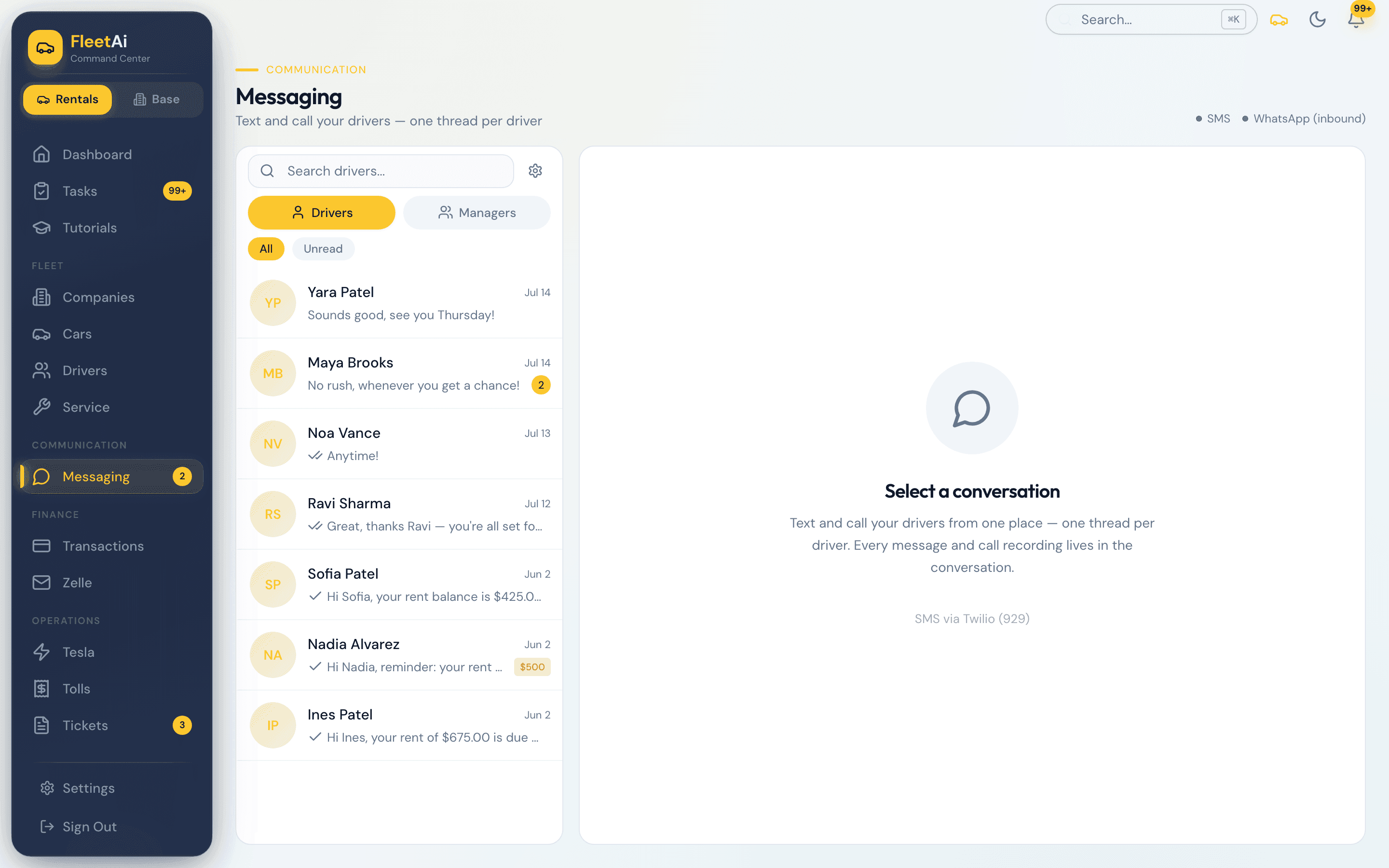
One number, not a personal cell
Texting a driver from a personal phone works fine for one driver and falls apart at ten. Numbers get saved under first names that don't match the account, a driver texts back at eleven at night, and whoever's phone the fleet has been using becomes the only person who can answer, or the only record of what was actually said.
A single business line for the fleet fixes the mechanics before it fixes anything else. Every driver texts the same number, whoever answers can see the same thread, and the fleet's side of every conversation lives somewhere other than one person's personal phone. That's true whether a fleet has three cars or thirty; more drivers just make the problem harder to ignore.
It also survives the ordinary changes a business goes through. A personal phone tied to one manager stops working the day that person is unreachable, changes their number, or is simply asleep when a driver texts about a car that won't start. A business line doesn't depend on any one person answering it, and the history of every conversation stays with the fleet rather than leaving with whoever's phone it was on.
Consent comes first
Sending an automated text to a phone number, in any context, is regulated the same as any other kind of business communication that shows up uninvited. Federal rules enforced by the Federal Communications Commission require consent before sending a text like that, and require it to come from the person receiving the messages, not assumed because the fleet has a phone number on file from a rental agreement.
The practical version of this is simple: ask, and write it down. When a driver comes on, get their agreement to be texted at the number they gave you, the same way the rest of their file gets documented. It's a small step that removes any question later about whether the number was theirs to text in the first place.
That consent doesn't need to be complicated to be real. It can sit in the same onboarding paperwork as everything else a new driver signs, stating plainly that the fleet will text that number about things like rent, overdue balances, and updates about the car, and that the driver can opt out at any time. Keeping that record costs a fleet nothing and answers the question before anyone has reason to ask it.
STOP means stop, immediately
The wireless industry's own messaging guidelines, published by CTIA, call for standard STOP-style opt-out language, and for treating any clear opt-out request the same way, whether it's the word STOP or plain language that means the same thing. Federal guidance goes further: a consumer doesn't need a specific word at all. Any reasonable way of asking to stop counts, and it takes effect right away, across every message the sender was using it for.
New York adds its own layer. In 2021, the state amended its telemarketing law to bring text messages under the same rules that already covered sales calls, meaning an unwanted text is treated with the same seriousness as an unwanted call. None of this is limited to marketing messages by its wording. Once a driver asks to stop, the number should come off every list it's on, not just the one that prompted the request.
Why this is worth doing properly
None of this is complicated, and none of it should feel like an obstacle to reaching a driver about something as ordinary as a rent reminder. Get consent when a driver comes on, keep every text going out from the same number, and treat a stop request as final the moment it arrives.
The alternative isn't a faster way to reach drivers. It's a phone number that eventually can't be trusted by the people it's texting, and a fleet that finds out the hard way which rules applied all along.
Questions fleets ask
- Do I need a driver's written consent before texting them about rent?
- Federal rules require consent before sending automated texts to a phone number, and the safest practice is to get it in writing when a driver comes on, the same way you'd document anything else in their file. It costs nothing to ask and it settles the question before it comes up.
- What happens the moment a driver replies STOP?
- Every message to that number stops. Federal guidance treats an opt-out as effective the moment it's sent, in whatever wording makes the intent clear, not only the word STOP itself, so it isn't something to interpret narrowly.
- Does New York treat text messages differently than other states?
- New York extended its telemarketing law to cover text messages in 2021, putting texting under the same rules that already applied to sales calls. It's one more reason to treat a text the same way you'd treat a phone call: consent first, and out the moment someone asks.
- Is a rent reminder to an existing driver the same as a marketing text?
- Not in intent, but treat it with the same discipline anyway. The number belongs to a person who can revoke permission at any time, and the underlying rules don't ask why a text was sent before they apply.
Sources
- CTIA, Messaging Principles and Best Practices (May 2023)
- Federal Communications Commission, Stop Unwanted Robocalls and Texts
- New York State Senate, Bill S3941 (2021), amending General Business Law Section 399-z
Built and used every day by a working NYC TLC fleet.