The lease already answers most of this
A driver who stops paying rent feels like a crisis the first time it happens and a procedure every time after that, and the difference is almost always whether the lease was written to answer the question in advance. New York City's leasing rule for for-hire vehicle owners requires a written lease stating the beginning and end of the term, every cost that can be charged, and, if a cancellation fee exists, the minimum notice needed to avoid it. A fleet that has all of that on paper is not deciding what happens when a driver falls behind. It is reading a document both sides already signed.
Fleets that skip that step end up negotiating each default from scratch, which is slower, less consistent, and far more likely to end in a dispute than a fleet that can point to a specific clause. The driver, for their part, is also better off knowing the sequence in advance rather than finding out what happens only once they are already behind.
The sequence that avoids a confrontation
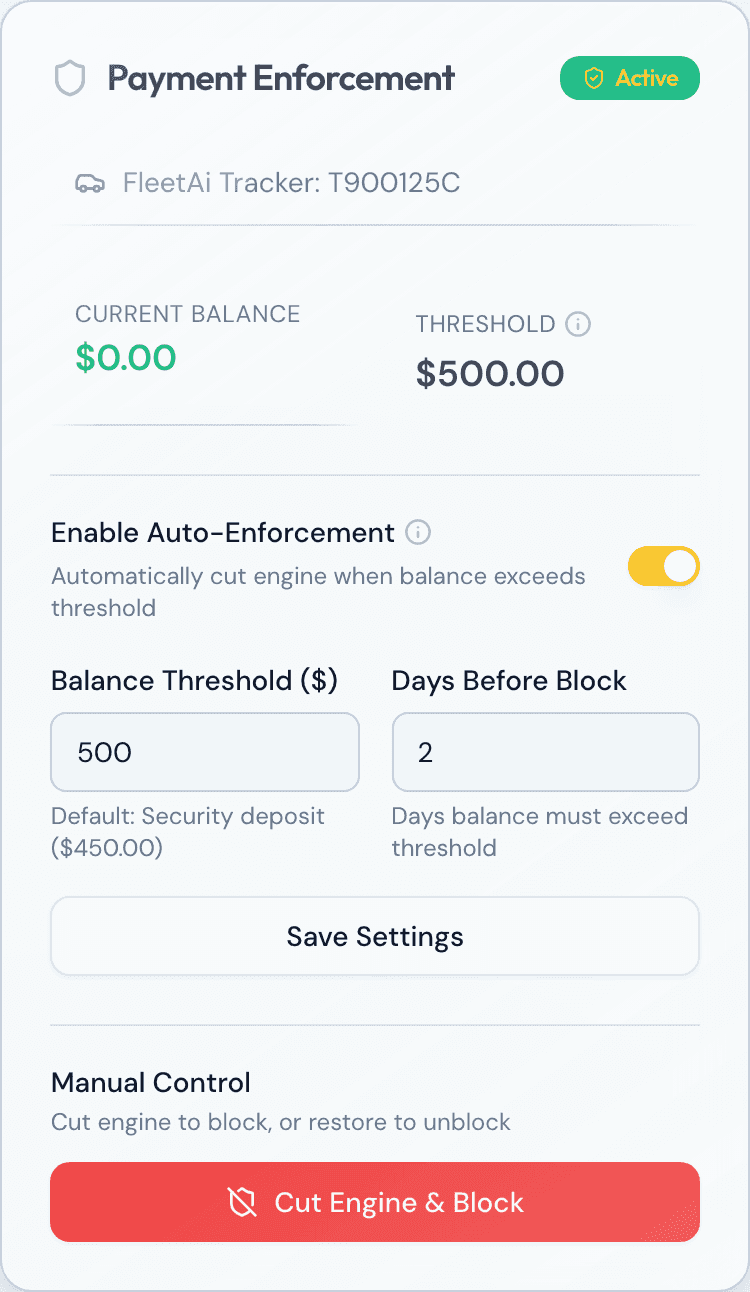
The steps that keep this from turning into a fight are ordinary on purpose. Reminders go out as the balance ages, the same way they would for any driver running a few days late. Once the balance passes whatever grace period and threshold the lease and the fleet's own process set, the next step, whatever it is, becomes available rather than automatic.
If that next step includes disabling the vehicle remotely, the one rule that matters most is timing: it happens only once the car is parked, never while it is moving. A car cannot be safely cut off in traffic, so any system built around this waits for the vehicle to stop on its own before doing anything. Recovering the car itself, if it comes to that, happens the same way, at the end of a lease term or under a cancellation clause the driver already agreed to, not as a roadside confrontation.
What the lease lets you charge, and what it never does
Even a driver who is clearly behind is protected by the same rule that protects a driver who pays on time. Only costs already written into the lease can be charged, a tip can never be demanded, and a summons written to someone other than the driver can never be passed along to them. The one exception, for a for-hire vehicle, is a parking ticket or a red-light camera violation from the lease period, and only if the driver had an opportunity to dispute it.
Stepping outside those limits does not just risk a bad conversation. It is an overcharge under the Commission's rule, with its own fine and a required repayment to the driver, which turns a fleet trying to collect what it is owed into the party in the wrong.
When it still goes to a complaint
Some drivers dispute the sequence no matter how it was run, and the outlet for that is the TLC's Driver Protection Unit, which investigates complaints about lease overcharges, unreturned deposits, and payment disagreements between an owner and a driver. What a fleet has to show at that point is not a version of events. It is the signed lease, the receipts for every transaction, and a record of when each step in the sequence actually happened.
That record is the entire reason the sequence is worth building before it is needed. A fleet improvising in the moment has a story. A fleet following a written lease has a file, and the file is what actually settles the complaint, not who tells it more convincingly.
Questions fleets ask
- Can I take the car back before the lease term is over?
- Only if the lease already gives you that right, such as a cancellation clause with a stated notice period. Without one, the vehicle stays with the driver until the term ends or renews, so that clause is worth having in writing before you need it.
- Can a fleet disable a car while it is being driven?
- Not safely, and not as standard practice. Any remote engine control is built to act only once a car has stopped and stays parked, because cutting power to a moving vehicle is a safety risk no fleet should take on.
- What can't I charge a driver who falls behind?
- Only costs already written into the lease can be charged at all. A summons written to someone else can never be passed to the driver, and even a parking or camera ticket from the lease period needs to have given the driver a chance to dispute it.
- What if the driver disputes the whole sequence?
- That is what the TLC's Driver Protection Unit exists for: complaints about lease overcharges, deposits, and payment disputes between an owner and a driver. A written lease and a record of receipts are what the fleet has to show when that happens.
Sources
- NYC Taxi and Limousine Commission, Rules, Chapter 59 (For-Hire Vehicle Owners), Section 59A-21: Leasing a For-Hire Vehicle
- NYC Taxi and Limousine Commission, Driver Protection Unit
- NYC Taxi and Limousine Commission, TLC Rules and Local Laws
Built and used every day by a working NYC TLC fleet.