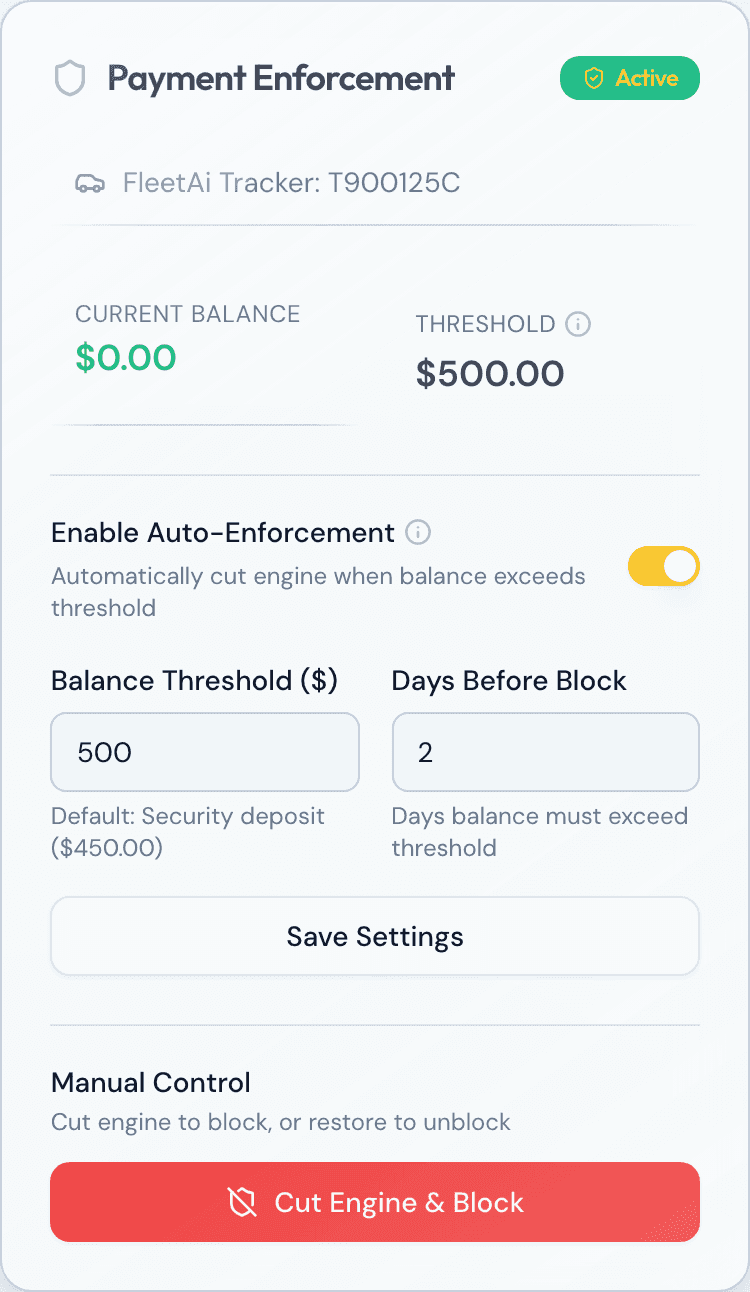
What a starter-disable device actually does
A starter-disable device is a small relay wired into a car's starter or ignition circuit. Triggered remotely, it stops the engine from starting the next time someone tries to start it. It doesn't touch a car that's already running, and it doesn't need anyone to visit the car to reverse it: the car starts normally again the moment the command is lifted.
That sounds simple, but it isn't legally neutral. The Federal Trade Commission's own guidance on these devices, written for car loans rather than car rentals, says that using one to press for payment can look like a repossession, or like a breach of the peace, depending on the contract and the state you're in. A fleet renting cars to drivers is a different relationship than a bank financing one, but the caution underneath it is the same. This is a tool that touches someone's ability to work, and it earns the seriousness that implies, not a shrug and a flip of a switch the day a payment is late.
The device itself doesn't know why a balance is unpaid. It doesn't know a driver is mid-dispute over a toll they say wasn't theirs, or that a payment already cleared and just hasn't been applied yet. All it does is act on whatever number it's told to check. That's exactly why the parts around the device, the threshold, the grace period, and the log, matter as much as the hardware does.
Only once the car is parked
The one rule that shouldn't bend: the device only acts on a car that is already stopped. A moving car with a disabled starter isn't a collections outcome, it's a safety incident, and no unpaid balance justifies the risk of a car losing power in traffic. The technology exists specifically because it can wait for a safe moment. There's no version of this that requires cutting a car off mid-trip.
In practice, that means a command queues until the car is parked, however long that takes, rather than firing the instant a threshold is crossed. A driver who's two days late but currently on a highway isn't in any more danger of not paying tomorrow than they were an hour ago. There's no reason to force the point before the car is sitting still.
A grace period, and a record of every command
Two things keep this from becoming its own problem. The first is a grace period: a stretch of time after a balance crosses whatever threshold is set, before anything actually happens to the car. That gap is what separates a driver who's a day late from one who has genuinely stopped paying, and it's the notice a reasonable person expects before losing the use of a car.
The second is a log. The Consumer Financial Protection Bureau's supervisory findings on auto lenders describe servicers activating these devices on accounts that weren't actually behind, because of errors in the servicers' own systems, not because anyone had stopped paying. That's the risk with any automatic system: it's only as good as the balance it's reading. A record of every command, when it was sent, what the balance was at the time, and whether it was automatic or a person's decision, is what lets a fleet catch a mistake like that fast, instead of finding out about it from an angry phone call.
Put it in the agreement
None of this should be a surprise the first time it happens. TLC-regulated lease agreements are already required to be in writing, signed by both sides, and to spell out every charge alongside the rule that allows it. The same logic covers a starter-disable device: if a driver's agreement includes one, it should say so in plain language, next to the threshold and the grace period that trigger it, before the driver ever signs.
That's a low bar, and it's also the entire difference between a driver who understands the terms they agreed to and one who finds out what they signed the day their car won't start. A driver who knew the rule going in has a reason to pay before the grace period runs out. A driver who didn't just has a reason to be angry, at a moment when the car is already the least of the problem.
Questions fleets ask
- Can a starter-disable device cut off a car while it's being driven?
- It shouldn't, ever. A device that can act on a moving car is a safety problem waiting to happen, not a collections tool. The command should only take effect once the car is already parked.
- Is disabling a car for nonpayment the same as repossessing it?
- It can raise the same questions. The Federal Trade Commission notes that whether disabling a vehicle counts as a repossession, or as a breach of the peace, depends on the contract and the state, which is exactly why the agreement needs to say the device exists before it's ever used.
- What should the rental agreement say about it?
- That the device exists, what triggers it, meaning a balance past a set threshold and past the grace period, and that it releases automatically once the balance is paid. None of that should be a surprise the first time it happens.
- What if the device gets triggered by mistake?
- It happens elsewhere in the industry. Federal regulators have found auto-finance servicers activating these devices from system errors, on accounts that weren't actually behind. A logged record of the balance and every command is what lets a fleet catch that fast and undo it.
Sources
- Federal Trade Commission, Consumer Advice: Vehicle repossession
- Consumer Financial Protection Bureau, Supervisory Highlights, Issue 28 (Fall 2022)
- New York City Taxi and Limousine Commission, Rules, Rule 58-21: Leasing a Taxicab or Medallion
Built and used every day by a working NYC TLC fleet.